Ultra-endurance cyclist Grant Lottering will push his limits to the extreme when he takes on the 24-hour Alpe d’Huez challenge in August.
The feared 13km alpine climb, made famous by the Tour de France, has a gradient of more than 8%, 21 hairpin bends and a summit at 1 810m.
The idea to take on the challenge, which Lottering calls the #24hourHuez, took root in June last year when he rode up the Alps with former rugby Springbok Joel Stransky.
“I’ve been thinking about a #24hourchallenge series and with the Alpe d’Huez being so famous, it would be a privilege to try this as a first attempt,” Lottering said this week.
The Alpe d’Huez was also where he finished his first Im’possible Tour in July 2014, eleven months after his near fatal accident. So it has a special place in his heart.
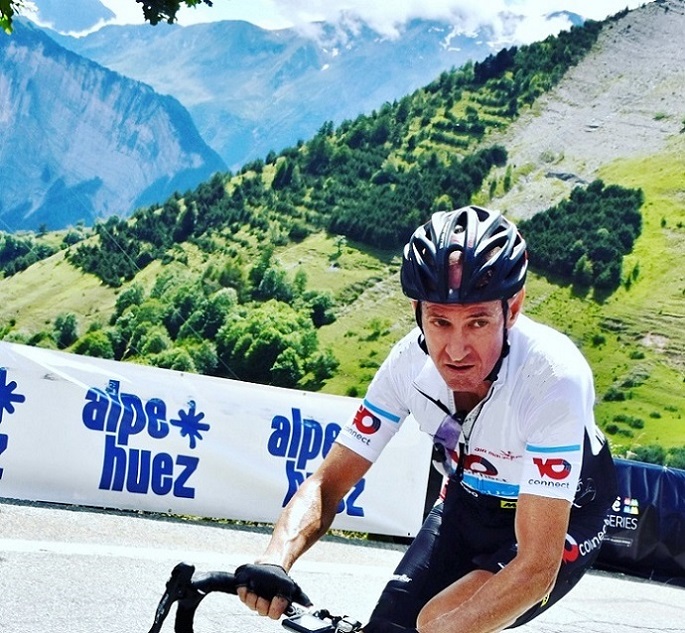
Ultra-endurance cyclist Grant Lottering will attempt the 24-hour Alpe d’Huez challenge in August as preparation for the Im’possible Tour a month later. Photo: Supplied
The fall was during a world championship preparation race. He entered a wet corner going downhill and crashed into a rocky embankment. He lost consciousness and his heart stopped beating.
Lottering spent eight days in intensive care and 12 days in high care before returning to South Africa for further treatment.
The Im’possible Tour enabled him to complete the race that had almost ended his life.
“Knowing I could have died on July 21 in 2013 completely changed my outlook on life and my feelings about my ability, mentally and physically,” he now says.
In last year’s tour he also endured freezing conditions and hypothermia, but refused to stop.
“In the end my support team got me off my bike after 20 hours and 410km. I learned a massive lesson from that.
“Doing extreme-endurance cycling is not about trying to be a hero or to impress people. It’s about pushing your own personal limits, inspiring others to believe they are capable of much more, and to realise our potential has no limits.”
Members of his support team drove next to him and read messages, comments and tweets of encouragement from his followers to him.
“It really boosted me, big time. We always need someone,” he says.
The 24 hour challenge will be his last ultra-endurance “training ride” before his Pyrenees and Alpine attempt.
For that, the challenge is to ride the length of the mountain range, which includes 32 mountains over 1 480km, including an elevation of 26 470m ‒ all non-stop within 72 hours.
“Spending 24 hours on a bike will certainly give me confidence. I’ll be climbing and descending multiple times. It will also be valuable mental strength preparation.”
Lottering will set off on the 24-hour challenge from 12pm on August 5. He hopes to set a record for the number of times he can complete the climb non-stop before finishing the next day.
But he is still working on an aggressive training plan as a result of a shoulder fracture during a crash on a training ride at the end of last year.
“I had two operations and effectively lost two months of endurance training. I maintained my fitness at home on the Wattbike.
“So, from April to the end of July every third week will be a ‘long week’, which includes three days of back-to-back rides of ten hours plus, ramping up to 15 hour rides by July.”
In between, he will have short quality weeks, and medium strength weeks.
He maintains a balanced eating plan, varying his intake with his output. “I have to be at my ultimate power-to-weight ratio by September 1. In my case 69kg is the ultimate weight for riding the big cols,” he says.
The beauty of ultra-endurance cycling, he maintains, is the recovery process. It boils down to the longer you ride, the more recovery time you need.
“I get three days a week off the bike during my long weeks and two days during my alternate weeks, plus a rest week.
“I do, however, continue my core home training on a weekly basis, which is essential for climbing so many mountains on the trot.”
To be an ultra-endurance athlete, one must have an absolute love for riding, as well as a deep appreciation and gratitude for being able to ride a bike, he explains.
“There are many great cyclists in South Africa who regularly ride endurance events of between 250 and 400km; in some cases even more. But when you venture into non-stop extreme-endurance cycling of 40 hours and more, you go to a different level.”
One needs an abnormal level of mental strength ‒ which could be trained for ‒ coupled with dedication and commitment.
“As I am not racing as such, I don’t always have short-term goals to keep me motivated. That is why breaking down the training plan into four-week blocks is crucial to remain focused.”
Gratitude keeps him motivated, he adds.
“For being alive, miraculously not paralysed, and being able to ride these famous Tour de France mountains that most cyclists only dream of… I am truly blessed. God has been good to me. That’s all the motivation I need.”


