South African road and track cyclist Maroesjka Matthee’s passion for the sport only developed relatively late and even though she has encountered immense hardship along the way her commitment to cycling has never waned.
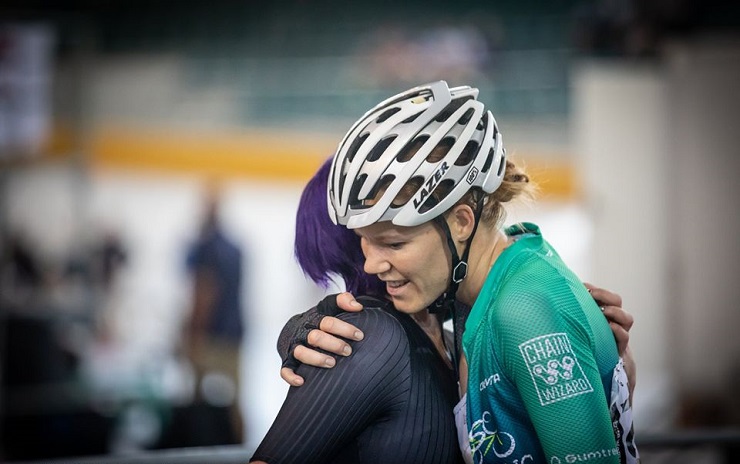
South African road and track cyclist Maroesjka Matthee’s commitment to cycling has never waned. Photo: Owen Lloyd
Interviewed by In the Bunch during the current hiatus in cycling races due to the coronavirus epidemic, Matthee gave some interesting insights into her rise to the top.
It has been a rise made all the more extraordinary by the fact that she has suffered numerous injuries, debilitating illness and an unintentional doping ban.
Outlining her introduction to cycling, she said, “Passion grows from something you enjoy. You need to be having fun for it to become a passion.
“Cycling was something I did with my dad and it was fun for me, but I never saw a future in it until I started racing on the track. Once I was a junior I started taking it a little more seriously.”
The 31-year-old, who this year signed with the Belgium-based Team Ciclotel but is currently in Cape Town due to the lockdown, said she was between 15 and 16 when she started doing rides with her dad.
“I was not taking it seriously but doing the occasional ‘fun ride’.
“When I was 17 I went to the Bellville Velodrome for the first time to watch Germany, Australia and South Africa race. This got me hooked.
“A week later I started riding on the track and I can honestly say the rest is history. My love for the sport started there,” said Matthee, who last year won the omnium at the SA Track Championships.
Matthee has spent some time abroad track-racing in the past and this will be her third year on the road. She spent three months racing in Belgium in 2018 and in 2019 spent four weeks with the national squad.
“I don’t have enough international road-racing experience to distinguish exactly how much of a change or difference there has been. However I can say that the level of our U23 ladies has seriously turned up the heat in SA racing, which is really exciting.
“My experience from a track perspective would be that the pre-Olympic year is always the toughest. The level of competition is extremely high, which is usually due to riders wanting to prove themselves to their federations to be selected for the Olympics.
“Or [they] try to pick up the last bit of nation points which helps qualify more riders. I’m sure it would be the same on the road.”
Matthee added that cycling was highly competitive and it was also prone to a lot of things not always going the way you intended.
“It’s inevitable that it will happen to everyone at some point. When things are going well, embrace it. The trick is to acknowledge, experience, accept, prepare and stay positive when things don’t go as planned and use the people who are there for you to help you.”
One early obstacle she had to overcome was when, at the age of 19 and just as racing had become her world, she contracted glandular fever.
“I’m the kind of rider who requires a lot of hours and training to do well, but I enjoy it so it doesn’t bother me.
“I was obviously over eager and without any guidance from a coach I over-trained. [Due to the illness] I spent about four to six months off the bike or with little training. It took about two years to fully recover from that.”
A year after that she had post-concussion syndrome, which is a complex disorder in which various symptoms last for weeks after the injury that caused the concussion.
“I trained too soon after having a concussion, so it was another six to 12 months of barely any riding.
“Once things started getting back to normal I crashed in training and fractured my pelvis, which was then followed by two fractured elbows and a shattered wrist that has left me with problems ever since.
“Each of these give their own obstacles and impact my life in many different ways.”
After the broken-bones years were over the broken-spirit period began, she said.
“I tested positive for pseudoephedrine as I returned to a good level. My world was ripped out from underneath me.
“Although the independent panel of judges found [it was] unintentional I still received a 12-month ban as the athlete is always responsible.
“I stayed motivated and had such an overwhelming response from my friends and family.”
She added that one had to experience and go through the bad days to appreciate the good ones.
“That shapes you as a person. And that’s not just one lesson; that lesson is lifelong.
“I have changed and developed in more ways than I can remember and I’m sure it will continue as one always tries to adapt.”
During her time riding and racing internationally she has created her own sporting survival travel checklist.
“Only speak Afrikaans until the person you’re speaking to asks if you speak English.
“When you’re in any public place with more luggage than you can handle – it happens – make sure to be wearing something that resembles SA. Internationals love us, but they just need to know that we’re from there first.
“Make friends at races – you need them! You can learn from them and they introduce you to other people.”
She added that being abroad was not easy. But she was not referring to the racing, which was actually the easy part for her.
“I’m referring to the living conditions, not being close to family and language barriers.
“These are often things we forget to take into account, but one thing’s for sure, going abroad is an amazing experience. And you will grow in more ways than just becoming a better rider.
“It’s something we all need to try and do at least once. No matter who you are or how good or bad you think your level of racing is, you’ve got to take the chance.
“I mean I know of someone who resides in SA and races phenomenally in Europe, but has no ambition to race in SA and is therefore always overlooked. So who knows, perhaps racing in Europe or America is your calling.”
Matthee said her training had been massively affected ever since the coronavirus outbreak, but as it was the same for everyone it made it easier to accept.
“I think the uncertainty of when we’ll be able to race again is probably the hardest part. You have nothing you can focus on to peak for. It’s all kind of building and maintaining for now, which is quite frustrating.
“Training indoors day after day can take its toll. My key to some sanity in it all is to spice up my normal training routine so that it doesn’t become so mind numbing.”
Matthee, who still wants to accomplish going to the Olympics, had specific advice for those looking up to her and also wanting to achieve internationally.
“Dream big and don’t be scared. Fear is very limiting and sometimes we just need to take that leap of faith.”


