Two days after Lance Armstrong publicly admitted to doping from the age of 21, we “sat down” with 46-year-old Malcolm Lange, whose career coincided with that of the Texan.
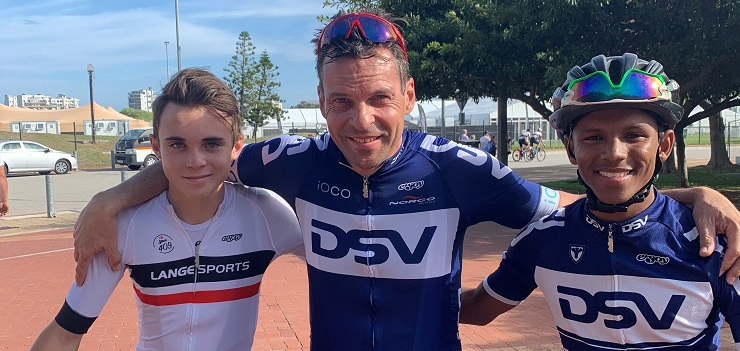
Three-time South African road champion Malcolm Lange (centre), who raced professionally from 1987 to 2011, has always been outspoken about doping in cycling. Photo: Supplied
Unlike the latter, the three-time South African road champion says he chose to turn his back on performance enhancing gimmicks during his 24-year career in which he amassed more than 400 race wins.
He spoke to In the Bunch from his home in Paarl, from where he still dabbles in the sport he loves.
In the Bunch: You have always been outspoken about doping. What was it like to be in the pro peloton during this controversial time?
Malcolm Lange: It was rife in the nineties! I matriculated in 1992, which was the Olympic year in Barcelona, so it was cool to be there in my matric year. This was the learning curve for me. I was not brought up knowing that cheating was the way forward and obviously you learn quickly that it happens in all sports. At that time, cycling was at the helm of it.
I know they just released an article on Armstrong admitting to doping from 21. I don’t know all the facts yet, but that’s pretty much what it was like. It was really the superior athletes who were impacted and it made a big difference in their performances, which would put them in a better light with regards to getting into bigger teams. It was a bit disheartening, because you gave everything you had, but you knew you just couldn’t go that next step.
On the positive side, it has been fantastic to see how it started to clean up and how the sport has evolved. I think you’re never going to stop cheats. They’ll always be there, but there are fewer. In our era, it was pretty much the norm to do it. In saying this, not all the athletes of that era doped. I guess I was very strongly opposed to doping and tried to be professional in what I did. It’s a short career and you have to make it count every time you’re on the starting line.
ITB: Did you ever feel that there was “peer pressure” to dope?
ML: You’ve got a choice in life and I just thought it didn’t fit my morals. I couldn’t understand how people slept at night knowing they actually cheated to win. I suppose it does happen every day – even in business. People always want to get ahead, so they will take risks. I’m just not that type of person. I think that’s why I brought my book Is Winning Everything? out. Because I was a winner and did like to win, but not at all costs. Coming second or third and getting off the bike feeling that you did it on your own is a way better feeling than anyone could imagine.
ITB: How frustrating was it seeing people perform in races, with a bit of extra help perhaps, while you were fighting it out the right way?
ML: You could never basically say a person was doping. You could think it, because some of the results and performances were out of the ordinary, but you only knew if testing was done and they were suspended. I think that’s what happened during my era. You looked at those great stars during the nineties and then it all came crashing down, but it took a long time to turn. I always say the wheel turns in life, and sometimes it turns slowly.
ITB: What is the most memorable doping excuse you’ve heard during your career?
ML: I think there were some interesting ones when people tried to duck and dive the testing. In the nineties, there was a case where an athlete would take a balloon that was filled up with urine and have a catheter, so it looked like they were passing urine but it was actually a balloon placed under their arm. When that got squeezed the urine would pass, but it wasn’t their urine going in. One rider who was caught was found to be “pregnant”. That was quite a humorous occasion.
ITB: What are your views on the latest Armstrong revelation? Having raced with him, were you aware of this at the time?
ML: The Lance era was an interesting one. I’ve always viewed him as having a similar build to myself. Not a general classification or tour rider, but one that would be good at world champs. I watched him race as a pro and I was there at the 1993 Worlds in Norway, which he won. I rode in the amateur category, which was won by Jan Ullrich.
Seeing what Armstrong did in the tours, it was a little bit too textbook for me. He would always shine in July and eventually became a top tour rider. Where that came from was way off. There were riders designed to win three-week tours. The reporter who kept eyeballing this thing right from the start – that was his exact observation too: that he was great for a one-day race, but not a tour.
Personally, I was a sprinter and I could win stages, but winning tours wasn’t my forte. I was a decent time trialist but I wasn’t the best climber, so my type of racing was aggressive. Getting the bunch whittled down to 12 or 13, getting over the climbs when I needed to and then packing a power sprint to the end.
So, with Lance, it was obvious back then for me, but I don’t think anyone would’ve believed me until it all came out. He did do a lot of good for cycling though in a sense of elevating it to a level where it became a cool sport to watch. It was so sad what he did to the sport – it was disgraceful.
One special win for me though was beating Armstrong at the 2010 Cape Town Cycle Tour.
ITB: As owner of Lange Sports and the DSV Pro Cycling Team, which consists of Gert Heyns and Arno du Toit, would you like to leave us with a few words of wisdom?
ML: Whatever you do, you have to have a passion and love for it. I was fortunate to be able to carry on with my passion beyond my racing days and I still try and put back into a sport which I believe was good to me. If I can help in smaller ways within our fraternity, I will.
Just be happy with what you can do and find a niche in the market that makes you stand out. There’s no reason to turn to doping to make yourself better. If you must do that, then rather stop. What’s the point? You’re just letting down a whole lot of people when you cheat.
To parents, I think the biggest thing is to not put pressure on your kids. Let them evolve into what they’re good at. My son is keen on cycling and want to make it a career, but I put no pressure on him. I’ll support him in every way and I think he’s learnt from me what the right and wrong way is.


