Here follows a profile of each of the upcoming Spring Classics races.
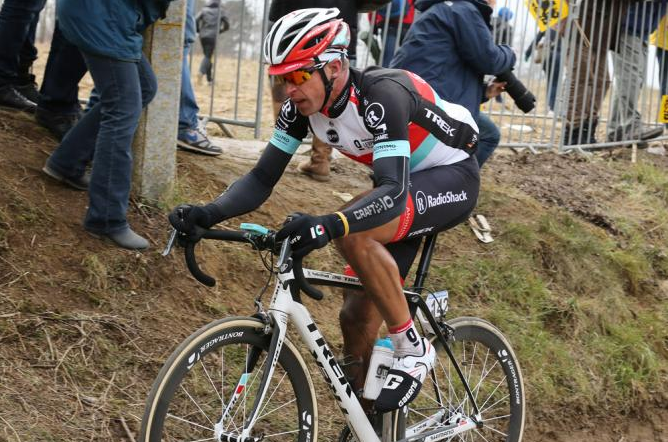
Stijn Devolder (RadioShack Leopard) is a two-time Tour of Flanders champion. Photo: Photopress.be
Tour of Flanders
One of the five ‘Monuments’ of the Classics season, the Tour of Flanders was first conceived in 1913 by Karel Van Wijnendaele, the co-founder of the sports newspaper ‘Sportwereld’. At that time it was customary for publishers to organise cycling races to promote their newspaper or magazine.
Belgian Paul Deman was the first winner of a 330km race that began and ended in Gent. This year’s edition will be considerably shorter at 259.1km, starting in Bruges and ending in Oudenaarde.
Although beginning along the North Sea coast, the route turns quickly inland and heads for the hilliest part of Flanders along the southern Belgian frontier with France. The toughest section of the race is the Koppenberg climb that has been dropped from the route several times due to its danger and difficulty.
Paris-Roubaix
For a race to have two nicknames tells you much about it and the ‘Queen of the Classics’ is also known as the ‘Hell of the North’. Although still known as Paris-Roubaix, the race has started in Compiegne, more than 50 miles north of the French capital, since 1968. What makes this race so brutal and exciting is the huge amount of cobbled sections.
There are 28 such sections in the 2014 edition ranging from 300-metres long to 3.7km and totalling 51.1km of the 257km route. That means more than 50km of potential pitfalls and hazards ensuring that riders face a challenge of merely staying on their bikes in the quest to arrive in Roubaix with a hope of victory. German Josef Fischer won the first edition in 1896.
Amstel Gold Race
The first of the Ardennes Classics, the Amstel Gold Race is the only World Tour Classic that takes place in the Netherlands. It has been running since 1966 when Frenchman Jean Stablinski was the first victor. It was set up by Dutch sports promoters Ton Vissers and Herman Krott, who ran a company called Inter Sport together.
The first edition was a disaster as although they announced a start in Amsterdam and a finish in Maastricht, the organisers hadn’t taken into account what route the planned 280km race would take. After differences with the local government, it ended up starting in Breda and finishing in Meerssen. Nowadays the race takes place in the southernmost Province of the Netherlands, Limburg, beginning in Maastricht and finishing in Valkenburg.
This year’s race will run for 251km with 33 climbs, including two ascents of the tough Cauberg (800m long with a 12 percent gradient) which features 1.8km from the finishing line.
La Fleche Wallonne
The one midweek race of the three Ardennes Classics the ‘Walloon Arrow’ was another created to boost sales of a newspaper, Les Sports, during the 1930s. Belgian Philemon Demeersman won the first edition in 1936 but although there have been 38 Belgian victories, one fewer than all the other countries put together, there have been only six since 1975.
Although this is not considered one of the ‘Monuments’ it is no less prestigious for that. And despite covering a ‘mere’ 200km, the gruelling Mur de Huy (Wall of Huy), which is climbed three times and comprises the finish, is an energy-sapping 1.3km at an average gradient of 9 percent with some sections up to 25 percent.
Liege-Bastogne-Liege
The final Ardennes Classic is also the oldest of the five Spring Classics featured here having begun in 1892 when Leon Houna, a Belgian, was the victor. In fact, it’s nickname ‘La Doyenne’ literally means ‘The Oldest’.
It will be a special edition as it is the 100th and will last for 263km. As its name suggests, it is run from Liege to Bastogne, and back again. There was a time when it and the Fleche Wallonne were run on successive days as ‘Le Weekend Ardennais’. That is no longer the case and mercifully so for the riders as Liege-Bastogne-Liege is known for its poor weather and long, steep climbs, which arrive with increasing regularity towards the end of the race. – Sapa / AFP
Watch this video by Team Sky about the Tour of Flanders and Paris-Roubaix.


