Cyclingnews caught up with the MTN-Qhubeka feeder team’s Till Drobisch, who snatched a surprise victory in his maiden outing at the Momentum 94.7 Cycle Challenge. The 21-year-old Namibian talks about last season’s crashes, challenges and changes, and ending his African chapter on a high note.
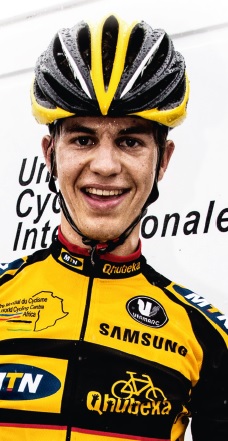
MTN-Qhubeka team member Till Drobisch.
Q: Winning the Momentum 94.7 Cycle Challenge in your maiden outing seems to be an unexpectedly great end to what has been a bit of a rough season, wouldn’t you say?
A: Yes, most definitely! It was so unexpected after I actually thought I wouldn’t be racing again last year, but it was exactly what I needed.
Q: The real lowlight was probably crashing out of Tour de l’Avenir. Tell us about that, your injuries and how it altered your plans for the season.
A: I had a few crashes last year. One of them was around July when I slid out on a wet road and took a hole the size of a golf ball out of the side of my hip. I missed out on a big Tour (Giro Valle d’Aosta) due to that injury and it took me quite a while to get my motivation and training back up again. Then shortly before Tour de l’Avenir I was feeling good again, managed to get through the flat stages without crashing or losing time and actually started thinking this might be a good tour for me. But then it was over before I reached the mountains. My plan was to qualify for the World Champs through a top 20 on GC and also get the attention of one or two pro teams. Obviously neither of those goals was possible and I must admit it was a tough mental blow and it took me a long time to get over it. I actually said my season was done after the crash, because there weren’t any big races left and if I started training again immediately I would peak too late for the last races of the season. But then our team coach, Andrew Smith, asked me to come down for the Momentum 94.7 Cycle Challenge anyway, even if I didn’t race. I’m very happy he asked me to do that, even if I hadn’t won.
Q: Did the enforced break from competition do you a favour in being able to peak in time for such a late-season race?
A: Yes and no. I was definitely not in peak shape and, honestly, also wasn’t trying to achieve that in training. Mostly I was rather doing strength intervals than speed intervals, which is not the optimal choice if you want to be racing fit. However it gave me the advantage in that I was still motivated and fresh in my mind, unlike most of the riders who have a long season behind them and are looking forward to a bit of rest.
Q: You didn’t go into the 94.7 as designated team leader, so did you think you could win or at what point did you realise it was possible?
A: I was feeling pretty good on some of the hillier training sessions, but I never thought about actually winning until our director, JP van Zyl, told me I had an outside chance to win. I didn’t believe him at first but later I thought he might be right because in cycling you never know what will happen. But I was still focused on working for our team leaders.
Q: Would you say that the hillier new route played to your strengths as a good climber? Or did you also have to employ your time-trial skills in the closing stages?
A: The new route definitely suited our team, and me, well. All the sprinters who were still there at the end were too tired to get over that last bit quick enough, which gave me the gap I needed to hold them off. However, I also had to use my time-trial skills when the others attacked on the climbs; because I wasn’t strong enough to follow those hard accelerations, I got dropped a bit but kept the power high and always reeled them back in.
Q: Do you think the tougher new route elevates the 94.7 to a classic that’s really challenging for the pros and not just an ordinary mass participation event?
A: It is a very challenging route, even for the pros, but it still favours the sprinters a bit more than the climbers because most of the climbs are not long enough. The sprinters can still use their power to get over the top and if they are still there at the finish it will be difficult to beat them (but not impossible). It’s a very challenging route nonetheless.
Q: The win has certainly put you in the media spotlight – how have things changed for you in terms of your public profile and confidence?
A: The only thing that has changed is that I’ve gotten a million congratulations, I’ve been in every newspaper and for the first time in my life I had to give a few interviews on television. But let’s stay realistic here. It’s not going to make me a pro if I win the 94.7, so my confidence hasn’t changed much. I know what I am capable of and I also know my weaknesses. A win here is something great, but it won’t change the fact that I still have a long way to go to be a pro.
Q: How big is the cycling scene back home and what opportunities are there for aspiring young pros?
A: Cycling in Namibia is not very big. It is growing but we lack events and riders. For the young riders who want to make it big in cycling one day, it is not a good idea to stay in Namibia. The racing is different – not so many tactics, not a lot of sponsors and not the best racing. Mountain biking is a bit better, but the best is still if you try to race in SA or overseas as much as possible.
Q: How long have you been with the MTN-Qhubeka feeder team?
A: Two years and before that I spent a year with World Cycling Centre Africa.
Q: And how has your time in Potchefstroom shaped your cycling?
A: My time in Potchefstroom has made me a cyclist. Before, I didn’t know anything about training, tactics and nutrition. But after being in Potch and Switzerland for three years, I have learned a lot and can actually call myself a bike rider.
Q: You’ve signed with French team Nantes Atlantique for the 2015 season. How and where did you first grab their attention?
A: When I was racing in Switzerland for CMC (Centre Mondial du Cyclisme/World Cycling Centre), their soigneur helped us out in one of the races and told me they were interested in signing me. Since I planned to leave the centre after this year and my coach in Switzerland was looking for a French team for me, I thought why not this one? They are a well-known first-division amateur team linked to two professional teams. It’s not easy getting into a team like that as a foreigner.
Q: Tell us a bit about your new role and opportunities in that team.
A: I don’t know what my role in the team will be because I don’t know any of my teammates yet. So we will have to wait and see. The opportunity that I will get is a lot of tough European racing, which will hopefully make me a more complete rider. The races around Nantes are very windy, cold and wet and I am still struggling a bit in those conditions, but I am eager to learn. I am also hoping to make some contacts with the two pro teams they are linked to (FDJ and Bretagne-Séché) and see if it will be possible to get a ride there if all goes well.
Q: Where will you be based? It’s obviously even further from home than Potch, so are you excited or already a little homesick at the thought?
A: I will be based in Nantes. Yes it is far away from home, but I am already used to it. I’ve spent six months in Switzerland each year for the last three years, which is not as long as I will spend in Nantes but it comes close, so I think once I’ve settled there and figured out how things work it will be okay.
Q: Do you see yourself racing for an African pro team in the future and what are your long-term career plans?
A: I could definitely see myself racing for an African pro team in the future. I was supposed to be a stagiaire for MTN-Qhubeka last year but then had my series of crashes. But we will see what will happen and keep the options open. My long-term plans are making the jump to the pros and riding a few Grand Tours. It is more like a dream though. An achievable dream nonetheless.
Q: What would you say are your top three career highlights to date?
A: Difficult to say. I’ve had a few decent results but nothing that stands out that much over the others. I would say my third place overall in the Tour de Franche-Comté was definitely a highlight due to the difficult stages and tough competition. We rode up to La Planche des Belles Filles, the same last two climbs on which Nibali won his second stage at last year’s Tour de France. A second highlight has been participating in the Tour de l’Avenir three times. I love that Tour, but we have a love/hate relationship, because I never achieved what I wanted to. Obviously, I can’t leave out the 94.7 Cycle Challenge win. I’ve never had this much media attention and the congratulations from people I don’t even know haven’t really stopped. However, I would also like to mention my Namibian national road and time-trial titles from 2013. It is something special to wear your country’s colours for a year. Unfortunately, this year I only managed to defend the time-trial title.
Q: How old were you when you first climbed onto the saddle of a bicycle?
A: I first started riding properly around the age of nine. We had training sessions after school every Monday and Wednesday and I think that’s where it all started.
Q: When did it first occur to you that you could make a career out of riding a bicycle?
A: Actually, it only occurred to me two years ago! After school I didn’t know what to study, so I decided to take a gap year and ride a bike at the WCCA in Potch. I struggled a lot and actually didn’t think I could make it, but decided to try for one more year. Apparently I learned a lot in that year of struggling and made a big leap forward. That was the first time I actually believed I could make it. Before that I thought about it but it was more like a dream; it didn’t seem like I would be able to do it.
Q: Complete this sentence: When I’m not on the bike, I . . .
A: . . . think about when I will be able to get back onto the bike. But I might start studying through Unisa this year so maybe that will change.
Q: What’s your next race? Are you doing the Sharjah International Tour?
A: Unfortunately there had been some complications and the Namibian federation was not be able to send a team, so there was no more racing for me at the end of last year. I started doing a lot of cross-training in preparation for this year.
Q: Will we see you back on our shores for the African Champs in February 2015?
A: I am not sure about that yet. It will be complicated for me, because I have to be in France on January 5 already and we have a training camp in Spain at the same time, but if there is a possibility I would definitely like to come.


