Cycling South Africa have reiterated their adherence to the regulation set out by the International Cycling Union (UCI), in which disc brakes are banned in road races.
But this does not apply to everyone, said Cycling SA’s general manager Mike Bradley.
“The UCI ruling applies to the elite bunch and all those who hold full racing licences and not the open classes from A to D.
“It doesn’t apply to those open, mass-participation rides where people ride on mountain bikes or road bikes. It applies to road racing guys because they are the ones affected by the UCI rules.”
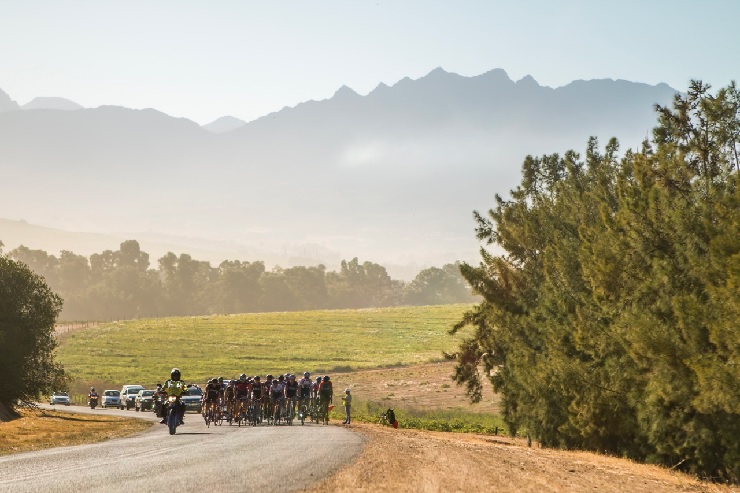
Cycling SA reiterated that they do not permit disc brakes in road races. Photo: Double ST
Simply put, anybody in the licenced bunches who have a following commissaire may not use disc brakes, he said.
Bradley explained that there were ongoing tests by the UCI to better understand the risks involved with the use of disc brakes.
The world governing body declared 2016 a trial year and allowed teams to use the brakes, but this came to an end in April when Movistar’s Francisco Ventoso crashed at Paris-Roubaix and severely cut his leg.
The Cyclistes Professionels Associés (CPA) then found that the majority of riders were against the use of disc brakes in road races.
“At this point in time I think the UCI would rather err on the side of safety until they have determined the effects of using disc brakes in the bunch,” said Bradley.
In the past, safety, performance and logistics have been some of the issues raised when it came to disc brakes, but Bradley said he felt safety was the main concern.
“Disc brakes originate from mountain biking, where you won’t find a 14km downhill where riders reach speeds of 70km per hour.
“The heat build-up in a disc brake is tremendous because of the increased speed.”
Bradley explained that this did not only affect the riders and that the mechanics who worked on the bikes could also be at risk.
“If someone comes into contact with this, whether it be a rider or even mechanic, they could suffer very serious burns.”
Due to their design, disc brakes are far more effective than their traditional counterparts when it comes to modulation and handling cornering or wet conditions.
This means riders with disc brakes are able to brake later, putting those behind them at risk of crashing.
However, Bradley said the decision was safety-driven rather than performance-based.
“A normal cantilever brake that you get on a road bike is way lighter than a disc brake, so if you want to look at performance, the heavier disc brakes negate the advantage of effectiveness.”
The UCI had to take into account factors such as performance versus safety before making their final decision, said Bradley.
As with any rule, there was a propensity for change, said Bradley, but he did not know if this one would.
“There are a lot of rules that the UCI could change, for example the minimum weight rule, but it all comes down to safety and knowing how the bike will react.
“The rule about disc brakes might change if they find a way of cooling the brake or shielding it from coming into contact with riders or mechanics.”


