There is a special place for Gran Fondo races in South Africa said John Swanepoel, founder of the Swartberg 100 Gran Fondo.
It was for that reason that Swanepoel decided to start the Swartberg 100, a 170km race starting and finishing in Prince Albert, Western Cape.
The race this year took place on April 28 and was won by Richard Simpson among the men and Yolande de Villiers among the women.
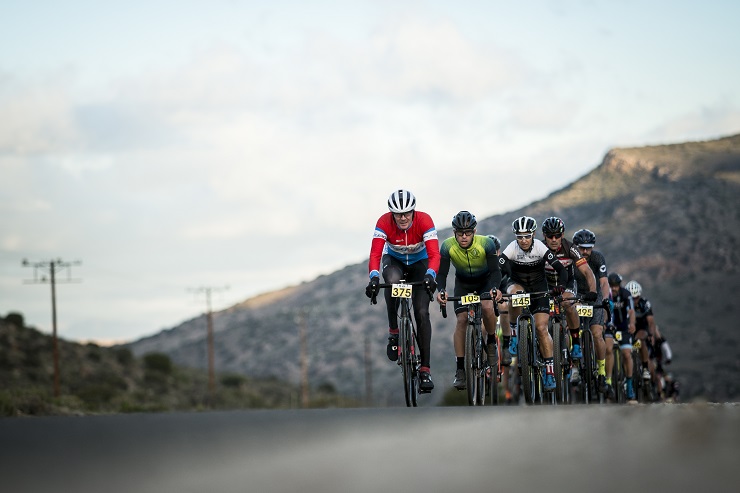
Riders in action during the Swartberg 100 Gran Fondo last month. Photo: Jacques Marais
Aside from the recently extended Amashova Durban Classic, which will form the final leg on the Gran Fondo World Tour calendar, Swanepoel said the country did not “seem” to make much provision for this type of race.
“I looked at what was happening around the world in terms of big rides in difficult terrains and I discovered that Gran Fondos are very common in Europe and America,” Swanepoel told In the Bunch.
“South Africa does not seem to host [many] Gran Fondos when there are hundreds of them in the north.”
Gran Fondo translated from Italian is a “big ride”, Swanepoel says. “It normally involves a race of around 170-plus kilometres and it normally has difficult terrains with a lot of climbing.
“The Strade Bianche [a 184km Spring Classic in Italy] is what inspired me,” he said, referring to the concept of racing on gravel and road where the race comprises more than 50km of white gravel.
He elaborated: “I quite enjoy the race tactics in a road-race and I also enjoyed the earlier days of mountain-biking on gravel where there used to be quite a bit of peloton riding.
“You eat stones and dusts, while also having tactics on the single tracks.
“The spring classics then interested me while researching Gran Fondos and I thought it would bring about a whole new aspect of cycling [to South Africa].
“It is refreshing and different. South Africa has so many gravel roads and amazing routes to use. Gravel bikes in these races seem to be the answer.”
He is, however, unable to categorically decide whether he would label the Swartberg a road or a mountain-bike race.
“It is neither,” Swanepoel said. “It is more road-race than mountain-bike race. But we are so brainwashed into thinking we either have to ride on tar, not going near gravel, or do mountain-biking while only hitting single tracks in a few-days’ stage race.
“I disagree with that. If you look at the Tour de France in the early 1900s, the cyclists would ride over passes that contained stones the size of your fist and their tyres were quite thick.
“If they rode in conditions like that then why can we not do so today? Equipment has driven us into thinking we have to specialise.”
The style currently did not fit in with cycling in South Africa but a new trend could be started, Swanepoel explained.
“It does not fit in with SA cycle races as yet. There is not even a category for it on Cycling SA.
“Hopefully the Swartberg can start that [process of change]. We need to wake up and look at some of the other bigger races around the world.
“We need to stop being single-minded in SA, of being either a roadie or a mountain-biker. We need to ride our bikes in varying terrains and race accordingly.”


