South African David George has enjoyed gravel races for a few years now and believes the discipline will become increasingly popular in South Africa.
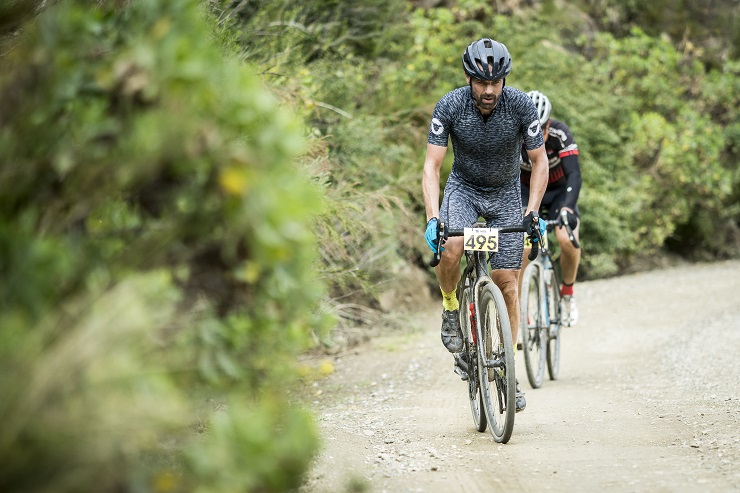
David George believes gravel races will become increasingly popular in South Africa. Photo: JMMPentax
The 44-year-old bases this on the fact that our rural scenery is beautiful and the opportunities to ride on gravel are almost limitless.
“With traffic increasing and road closures becoming more and more difficult, gravel will become more popular.”
He noted that the gravel sector of cycling does not currently fall under the UCI/CSA umbrella. This freed it up from “stifling antiquated rules and regulations” that normally stopped events even before they happened.
“The USA has seen an explosion in the number of events and participation. The UCI are having to re-think their business. Hopefully gravel remains free.”
George, who owns the bicycle retail store Gear Change in Mowbray, Cape Town, said it had been interesting to see the popularity of gravel bikes grow in stores.
“Last year only the cool kids were buying gravel and then they were really bespoke builds. This year we have had a lot of calls for aluminium mid- to entry-level bikes for people just looking for the versatility.
“It has been a forecasting nightmare for the whole industry.”
For George, it is definitely the future of mass participation road events.
“Fun rides are no longer getting the numbers as there has been little innovation and people are looking for something more.
“Road events are unsustainable as traffic increases and safety on our roads decreases. People will train indoors more and look for events to keep them in touch with nature.”
George participated in the Gran Fondo race at the Swartberg100 in Prince Albert last year and placed in the top-10.
“I was blown away by the event and style of racing.
“I really enjoy riding gravel and in particular racing gravel. It’s kind of pure but edgy. Skinnier tyres and no suspension with longer 100-miler events are demanding and fun to race.
“Events like Swartberg100 are an amazing day out on a bike in the most beautiful and iconic scenery.
“I no longer have the time to compete as much as I did but I do still love the long hard days out on a bike; the training, racing and fellowship. Even though I’m slower and the competition are half my age.”
This year would have been his eighth Cape Epic, but the event was cancelled due to the current coronavirus outbreak.
“Justin [Tuck] and I were tee’d up to ride Epic and we had prepared a whole service team to take care of our usual ‘service package’ clients, so cancellation was the immediate effect of Covid-19 on our business and personally.
“As things have unfolded globally those losses seem insignificant. Everybody has lost or will lose something. Our retail business is closed for at best 21 days. This puts a huge amount of stress on us, our vendors, landlords, etc. Fragile businesses will fall now and we will all have to work hard together to survive.”
He said it had been interesting to see how the community were shoring up to ride more during lockdown and when it became clear that this would not be possible outdoors, there was a binge buy on home trainers.
“You would not believe how many phone calls we had from customers looking for stock.
“People are resilient and love to ride their bikes.”
In the build-up to lockdown, George observed a closer bond between parents and their kids on their bikes and in general more riding (and more happiness).
“It sounds corny but I think we’re all being taught an important lesson in appreciation. More people will come to bikes. Depending on the depth of the recession I predict more riding in our future.
“There will be a contraction in terms of the number of retailers, distributors and races, which ultimately will be good for the bike trade. It has become really crowded with poor business and service practices affecting the profitability of those that do their best to get it right.
“I think Covid-19 may have ‘ripped the plaster off’ the industry in general and only the strong will survive and thrive.
“I see a lot of positive outcomes for society and for bikes as we reboot.”
As a former Olympian, he has a strong opinion on the postponement of the 2020 Tokyo Olympics.
“A part of Olympic participation is the qualification, preparation and an athlete’s journey to the Games,” said George, who competed at the 1996, 2000 and 2008 Olympics.
“It is obvious now that qualification cannot happen as it should. With different countries in different stages of outbreak and lockdown it would be a completely unfair competition.
“It would also only serve to encourage athletes to avoid their lockdowns and potentially further spread the disease.”
He added that apart from the immediate danger of congregating a mass of people from around the globe in one place, the run-up to the Games could not happen as it should.
“We’ll have the Games next year and it will be just as exciting.”
Regarding all the other events that have been cancelled or postponed, George said economically events that depend on all their income through one annual event will struggle to survive.
“Cape Epic’s infrastructure was all up and resources were ready to go. Money was spent and it would be financially crippling for the organisers to now roll over entries to next year.
“On the up side we will continue to ride our bikes and love watching the races. The world as we know it has changed. There will be more races, it will be different, we will do things differently and appreciate our bikes differently.
“Races will change to different times and so who knows? Maybe sani2c in December will be a refreshing change. Things always happen for a reason.”
George’s plans now are to survive the global crisis and continue to grow and learn as a bike-fitter and bicycle retailer.
“I also want to ride more with my family and hope they get as much pleasure out of bikes as I have, and be a lifetime athlete and still find goals to keep me stimulated as I get slower.”


