Former Springbok cyclist Walter Thornhill’s most recent adventure has been a literary one. He recently completed his memoir, Eye of the Child, which took him on an intriguing journey of exploration and discovery.
“The idea of writing a book entered my mind just over four years ago after listening to the Dalai Lama’s teachings in Dharamshala, India,” he said.
“What initially influenced my book was a three-month sabbatical to try writing about what I was not sure. It slowly morphed and evolved from there, with huge support from many.”
The author, facilitator and public speaker describes his book as a survival story, filled with wonderful imagery and descriptive cycling anecdotes.
“This is an inspirational tale of survival – a sportsman, who knows the loneliness of endurance training, the reality of breaking through the cyclist’s wall of pain and the elation of bursting from the pack to win the stage in that final wild sprint for the line,” said Thornhill.
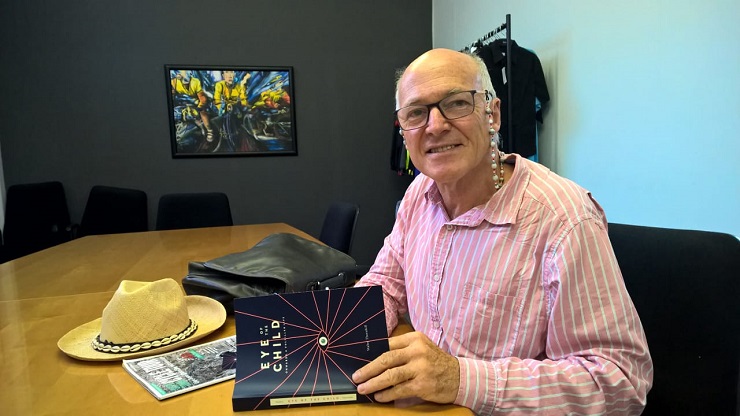
Ex Springbok cyclist Walter Thornhill with his memoir Eye of the Child, which he describes as a survival story filled with wonderful imagery and descriptive cycling anecdotes. Photo: Supplied
His cycling career started when a challenge was issued by a friend at school.
His book records the exchange: “My classmate challenged, ‘You’ve had your racing bike for over six months and haven’t even raced?’
” ‘Where can you race?’ I asked, not knowing there was such a sport. ‘In Fontainebleau!’ came the reply.
“Not the French one, but a northern suburb of Johannesburg some 15 kilometres from Kensington, where I lived.
“So, by 13 I had discovered cycling. It became my escape and sanctuary from a traumatic home environment.”
Highlights throughout his career were winning the 1 500m SA Track Championships in his first year as a senior (aged 19) in 1972 and again in 1976, winning the coveted Paarl Boxing Day 25-mile Minnaar trophy at 22 years old in 1975, and being awarded Springbok colours in 1976.
“Also, strangely enough, a third place at the Schoolboy Road Championships at the age of 15 in 1968 which was unexpected and became the encouragement for the road ahead,” he said.
Thornhill, who retired from the corporate world of international banking and consulting, said the book was filled with many highlights.
“It touches on inspirational mentoring by people like 86-year-old octogenarian Tommy Shardelow [who is one of the last of the 1952 Helsinki Games Olympians still alive], as well as Springbok cyclist Jack Lester and my training gang,” he said.
Thornhill’s other cycling heroes were Ralph Smout and administrators like Basil Cohen, Raoul de Villiers and Gotty Hansen (presidents of the South African Cycling Federation).
“They were people I looked up to, primary role models who unconsciously gave me a sense of belonging to the family I never had. In my youth, unconsciously, the cycling fraternity became my family.
“Those formative years set an important basic platform of survival which has stood me in good stead since. Jack sums it up well (one of his maxims), ‘There is nothing we cannot do provided we set our minds to it’, and that cycling taught me in spades,” he said.
In the book Thornhill tells of a tough and challenging upbringing.
“It was very traumatic and bewildering to navigate the paths thrust upon my sister and me through the damage of alcoholism and its varied consequences. Cycling was my saving grace, my anchor.
“The book talks about the story of a lost and often neglected little boy, the son of two alcoholic parents, who was shunted from pillar to post and hurt in ways that no youngster should be hurt,” he said.
Thornhill felt philosophical and healing insights were most important aspects of his book.
“Upon reflection, something shifted over the four years of writing. The true gold of healing rests deep within, encrusted with a delicate coat of compassion for all living things and a softness for forgiveness. All the answers we ever need are staring at us if we only know how to look and read nature properly,” he said.
When Thornhill first started writing the book he often had doubts as to whether he could do it.
“Actually, I’m petrified to write – it makes me accountable. Now I know otherwise. There were times I questioned whether I would publish or not, particularly as intimate details are now in the public domain,” he said.
Thornhill felt there were lessons to be learnt from the book.
“There is always a way through the maze. It depends on an inquisitiveness for ‘life’ on this beautiful planet we live on. I would like to quote from [expo company CEO] Chet Burchett’s endorsement, ‘Experiences which may seem small in the moment shape character. Perseverance begets strength, and in strength there is always hope’.”
Thornhill concluded with a wish he said he had for all of us, which is, “To live the opportunities presented within the paradoxes of life. And may our journeys be meaningful and fulfilled!”
Eye of the Child can be ordered via www.walter-thornhill.com.


