Cycling South Africa’s Bonga Ngqobane has admitted that the federation has lost credibility following the recent withdrawal of riders from global events due to lack of funding.
Ngqobane, who on behalf of Cycling SA coached the South African teams that took part in the Tour de L’Espoir and Tour de Taiwan this year, said this was largely due to administrative problems “in the structure itself”.
Just recently both Carla Oberholzer and Joanna van de Winkel – two top SA cyclists – opted out of the elite women’s UCI Road World Championships for which they were selected.
National marathon champion Gert Heyns withdrew from the marathon world champs and HB Kruger and Stuart Marais followed suit.
In the women’s category, Amy McDougall and Samantha Sanders also both decided not to compete at worlds.
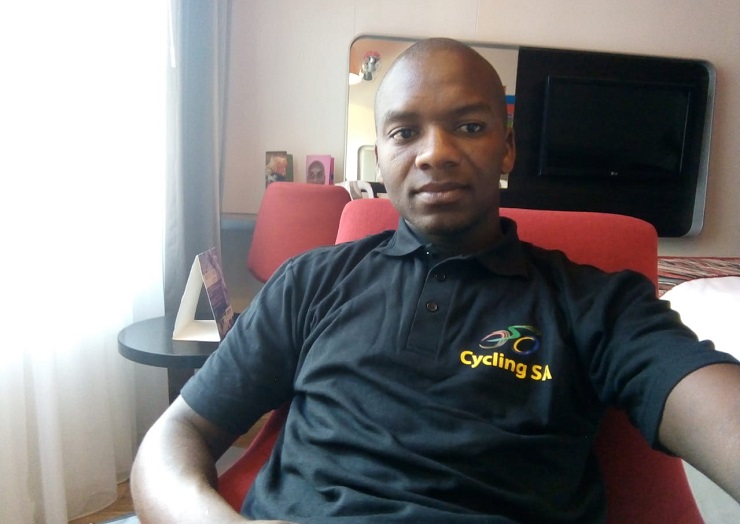
Cycling South Africa’s Bonga Ngqobane (pictured) has admitted that the federation had lost credibility following the recent withdrawal of riders from global events due to lack of funding. Photo: Supplied
Ngqobane, the federation’s transformation and development commissioner, shed some light on what has become a trending topic during the world champs season.
“There are currently administration problems within the structure itself and Cycling SA is now at the point where they have lost all credibility,” Ngqobane told In the Bunch today.
“There are certain people within the structures doing their part in terms of delivering to the sport as well as working together for plans to secure sponsors for funding.
“But, like in any organisation, there are a few individuals who are not fully committed,” he added.
Ngqobane said the federation had been “under pressure” regarding its financial status. Cycling SA have been “working tirelessly” to restore the status of cycling in the country, he said.
“There has been a lack of management and administration and, in some cases, there have been delays in terms of collecting race levies, day licence fees and insurances being lost.
“When the riders’ insurances erupted, Mike [Bradley, Cycling SA general manager] has tried by all means to manage the situation and make sure no riders take part without insurance cover.
“Mike and the team managed to work smartly to collect race levies in time and then the financial situation of the federation started to look better [as a result].
“Cycling SA is under tremendous pressure and, with all the riders withdrawing from the world champs events, the organisation has dented its name and has lost its credibility.”
Ngqobane promised, though, that the funding issue surrounding the international participation of riders would be rectified in due course.
He added that Bradley and his team were working to repair the federation’s tarnished reputation, but admitted it was “not going to be easy” and that “it will take time”.
“The people from outside, who are not close to the organisation and who do not understand what’s going on within the federation, do not know what we are currently going through,” Ngqobane said.
“We are trying by all means to sort this situation out and make sure it doesn’t continue in the long run.
“But at this stage it is out of our control as we do not have a corporate sponsor.
“Even the government is not doing enough to help the association; to enable us to be active and run the sport efficiently.”
One reason Ngqobane felt they were struggling to secure a major sponsor was because of a lack of exposure of the sport at a national level.
“The sport has a problem with television coverage,” he said. “Corporates do not want to place their money somewhere where they do not see the return on investment.
“Secondly, there is uncertainty around the results. When you invest you want to see the outcome of your investment.
“There are no guarantees that if you put your money into this that it will give you a profit in return in the long run.”
The provincial levels, he said, were also not cooperating with the federation, adding that “there are many challenges on the go”.
“We need proper administration to collect race levies from events happening all around the country,” he said.
“It takes time for the levies to reach Cycling SA, preventing us from facilitating [matters] for the sport.
“If the provinces, and even event organisers, can cooperate with the federation only then will the sport be able to grow.”
Ngqobane said money in the sport in South Africa had certainly not run dry, with events taking place on a weekly basis, each of which generated their own sources of income.
He urged the organisers of such events to turn their focus to the bigger picture.
“If the event organisers are not helpful to the sport they will only affect themselves by not helping the sport grow.
“Eventually, in the long-run, people will get tired of paying money to go to events and not be able to see where the money goes.
“It’s not just about the people taking part in the event but also about growing the sport at international and elite levels, where we can see more numbers going to the world champs.”
The development of the sport was paramount at provincial and district level, he added.
Ngqobane said he did not see any change happening in the future unless there was more cooperation with “the right people placed in the right positions within the regional structures”.
“If we do not have the support from the regions then there is nothing we can do. It needs to be a collective job; we can only do so much.”
He reiterated that in the sport’s current situation if a rider were selected for national duty to race abroad then they could seek funding from their provincial authorities.
“The provinces have the money but no one is going to them to ask for funding.
“There are many support structures within the provinces and I don’t think that has been communicated to them.”


