Dimension Data’s Ryan Gibbons enjoyed some successes, specifically on the sprinting stages, during the 21-stage Giro d’Italia which concluded in Rome on Sunday.
However, the South African said the Grand Tour was a lot harder than in previous years.
“The Giro this year was a hard one,” Gibbons told In the Bunch today. “Basically the whole peloton said it was a big step up from previous years.
“It was definitely on another level since I did it last year. The racing was just on every day, no matter how the stage looked.
“It was just absolutely crazy the whole time. The stages were so long, competitive and fast.”
He said one of the major challenges throughout the tour was a “lack of support”.
“As team DiData we came to the Giro as a climbing team and we had a lot of belief and focus on a general classification result with Louis Meintjes and Ben O’Connor.
“I came into the tour as the wildcard sprinter, just to see what I could do and when, but not having a lead-out man or a lead-out train was quite a challenge.”
Meintjes withdrew from the race after stage 16 due to illness, with O’Connor crashing out of contention on stage 19.
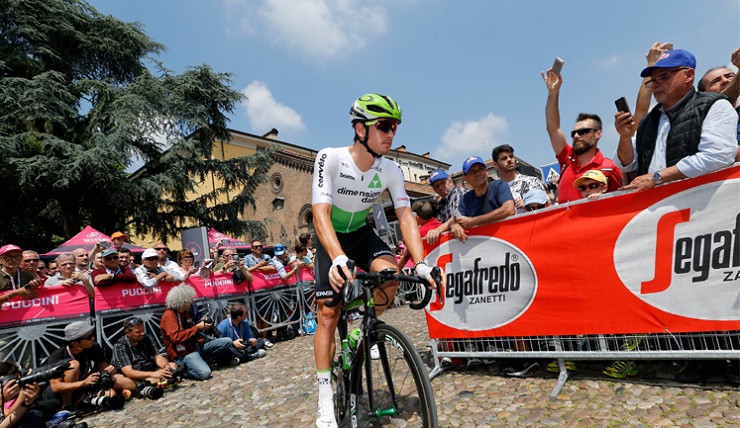
Dimension Data’s Ryan Gibbons enjoyed some successes, specifically on the sprinting stages, during a challenge-filled Giro d’Italia. Photo: Stiehl Photography
Gibbons, one of the renowned sprinters within the DiData set-up, still finished in the top-10 in two sprint stages – stages 2 (7th) and 13 (5th) – and just outside the top-10 in four others – stages 7 (14th), 12 (16th), 17 (11th) and 21 (14th).
He said he had hoped to build on last year’s Giro, where he made his Grand Tour debut and racked up six top-10 finishes in the 16 stages where he featured.
“I got a lot of confidence from last year,” Gibbons said. “I was in a similar situation of not having that true support but I managed to place in the top-10 on all the sprint stages I took part in.”
This year things didn’t go quite as well. “It was great to be up there and get a couple of top-10s, but for me it was more of a disappointment. I had higher hopes after last year.”
Gibbons said what was important for him in order to execute his sprints well was to focus on one rider he believed would be good on that specific day.
“I would then fight for his wheel,” he said. “I would target a guy like Sam Bennett, who won three stages.
“On two of the stages I decided to not even look around or worry about anything else, but just follow his back wheel.
“That was my tactic – whether right or wrong – but it was kind of the thing I was forced to do.”
Gibbons explained that the pace on the sprint stages usually started climaxing in the final 10km of the race.
“The teams who know they have a strong sprinter with good team support try to make the pace as fast as possible – to be able to stop riders like myself from moving up.
“Every corner, small climb or detour then becomes a bunch up, because every rider thinks they can take advantage of those sections to get ahead.
“There is often only space for one or two riders, but 20 riders try to push through to move forward. Inevitably, there would be crashes, bumps and a lot of braking.
“The guys at the front almost go through unscathed, but then there is more work for the riders behind.”
He said heading into the final kilometre, depending on the circuit, the racing became a “complete scramble”.
“The Giro this year only had about one or two stages with straight-forward, open and wide roads leading to the finish.
“A lot of the others were quite technical with a corner in the last kilometre or containing barriers which narrowed.
“The riders who had teammates were in tooth-and-nail fights to hold the wheels of their lead-outs, while guys like me tried to move up but at the same time piggyback off someone else.
“It all lends itself to a lot of swearing, elbowing and bumping. Some riders, like the Italians, do not give a crap. They would erratically move their bikes to bump a passing rider.
“It comes down to how brave, confident and even stupid you are.”
The real sprint was then “instigated” in the final 300 metres, Gibbons explained.
“Bikes just start going in every direction and it is difficult to decide where to go. You just have to see where there is an open spot [to break through].
“You can have a plan in your mind, but if you are not in the front three you often get boxed in and you cannot find a way out.
“When you are in that system you just have to try and make it work out for you.”
Team Sky’s Chris Froome won the overall Giro, his third Grand Tour title in a row.


